












News


 电商部
电商部  2026-01-21 10:28:20
 P/E Cycle and TBW of Industrial-grade Memory Card: How to Calculate Service Life?
In scenarios like industrial automation, rail transit, and financial terminals, the service life of memory cards is directly related to equipment operation and maintenance costs and system stability. A failure caused by exhausted memory card life can lead to significant losses such as production line shutdowns and data loss. P/E cycle and TBW are the two core indicators for measuring the service life of industrial-grade memory cards, yet most users have misunderstandings about their definitions, correlations, and practical applications, which can lead to incorrect selection and affect long-term equipment operation.
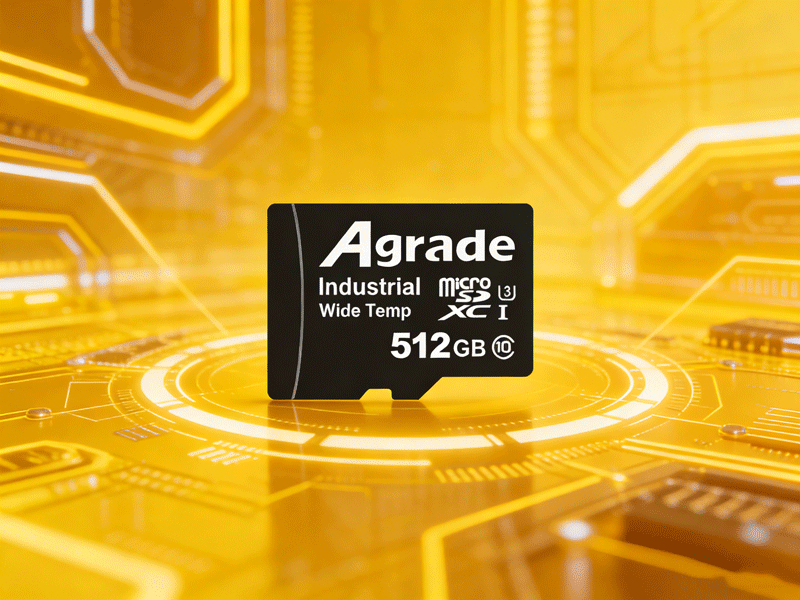
P/E cycle refers to the process in which a flash memory chip completes one full "erase old data - write new data" cycle, serving as the basic measure of the physical life of flash memory. Since flash memory chips have a physical limit on erase-write times, a higher P/E cycle count means a longer theoretical service life. Different flash memory types have significant differences in P/E cycles: industrial-grade cards using SLC (Single-Level Cell) flash memory can achieve over 100,000 P/E cycles, and some military-grade models even exceed 1 million times. MLC (Multi-Level Cell) flash memory offers 10,000 to 30,000 cycles, while TLC (Triple-Level Cell) flash memory used in consumer-grade cards only has 3,000 to 10,000 cycles, with actual life possibly shortened by writing frequency.
TBW is a more intuitive indicator than P/E cycle, representing the total amount of data that a memory card can safely write throughout its lifespan, usually measured in TB. TBW is directly related to P/E cycles, and the simplified calculation formula is: TBW = Flash Capacity × P/E Cycle Count × Flash Type Coefficient (1 for SLC, 0.5 for MLC, and approximately 0.33 for TLC). Industrial-grade cards generally have a TBW of ≥50TB, and high-end SLC models can reach hundreds of TB, while consumer-grade cards typically have a TBW below 10TB.
For example, a 16GB SLC industrial-grade memory card with 100,000 P/E cycles has a corresponding TBW of about 1,600TB. If the device writes 50GB of data per day, the theoretical service life can reach 87 years. Even a 16GB industrial card using MLC flash memory has a TBW of 480TB, which can last 26 years with 50GB of daily writing, fully meeting the long-term needs of industrial scenarios. Actual service life is also affected by usage scenarios, writing modes, and ambient temperature. The wear-leveling technology of industrial-grade cards can extend actual life by 20% to 50% by intelligently distributing data. When selecting, calculate the theoretical life based on daily writing volume and reserve more than 30% redundancy.

-
Products
Advantages
-
Solutions
-
News
About us
-
Contact us
Tel:+86 19926658803
Whatsapp:+86 19926658803
lianle1210@163.com
Address: 30CF, Caihong Building, Caihong Road, Futian District, Shenzhen City, Guangdong Province, China


Friendly Links:
