















News


 电商部
电商部  2026-01-21 10:29:25
 Wide Temperature Characteristics of Industrial-grade Memory Card: Stable Operation in Extreme Enviro
Industrial equipment is often deployed in extreme environments such as outdoor base stations, high-temperature smelting workshops, cold storage, and plateau areas. Temperature, as a core factor affecting the performance of electronic components, has a decisive impact on the stability and service life of memory cards. Ordinary consumer-grade memory cards are prone to read-write failures, recognition errors, and even permanent damage in environments with large temperature fluctuations. The wide temperature design of industrial-grade memory cards is designed to cope with extreme temperature challenges.
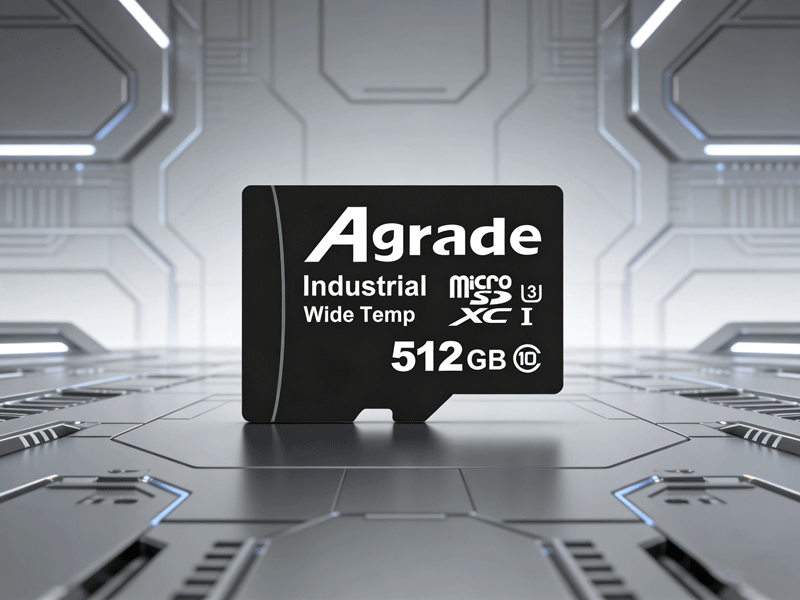
Consumer-grade memory cards typically have an operating temperature range of 0℃ to 70℃, only suitable for indoor room temperature scenarios. When the temperature is below 0℃, the conductivity of flash memory chips decreases, leading to sharp drops in read-write speed, data writing failures, and long-term low temperatures may cause capacitor aging and poor interface contact. When the temperature exceeds 70℃, thermal noise of flash memory chips increases sharply, significantly raising data error rates, and chip packaging materials are prone to aging and deformation, shortening service life.
Industrial-grade memory cards greatly expand the operating temperature range through targeted technical optimizations, generally supporting -40℃ to 85℃. Some military-grade models can achieve an ultra-wide range of -55℃ to 105℃, easily coping with low temperatures in northern winters, high temperatures in southern summers, and extreme temperature differences in industrial workshops. The realization of wide temperature characteristics relies on technical support in hardware, circuits, and packaging.
In hardware selection, industrial-grade high-temperature and low-temperature resistant flash memory chips and control chips are adopted, which can maintain stable electrical performance in extreme temperatures. In circuit design, line layouts are optimized to shorten signal transmission paths and reduce temperature impact on signal stability, while heat dissipation circuits are added to lower chip temperature rise in high-temperature environments. In packaging, high-temperature resistant materials are used, combined with metal casings or heat dissipation coatings to enhance heat dissipation and electromagnetic shielding. When selecting, match wide temperature parameters with the actual environment and verify third-party test reports to avoid inferior products.

-
Products
Advantages
-
Solutions
-
News
About us
-
Contact us
Tel:+86 19926658803
Whatsapp:+86 19926658803
lianle1210@163.com
Address: 30CF, Caihong Building, Caihong Road, Futian District, Shenzhen City, Guangdong Province, China


Friendly Links:
