












News


 电商部
电商部  2026-01-21 10:30:44
 Pros and Cons of Industrial-grade SLC Memory Card: Which Scenarios Require It?
As a high-end type in flash memory technology, SLC (Single-Level Cell) flash memory is known for its extreme durability, stability, and data security, becoming a core configuration of industrial-grade memory cards. Compared with MLC and TLC flash memory, SLC stores only 1bit of data per cell. Although it does not have advantages in capacity and cost, it shows irreplaceable value in industrial scenarios with high stability requirements. Clarifying its pros and cons and applicable scenarios helps precise selection.
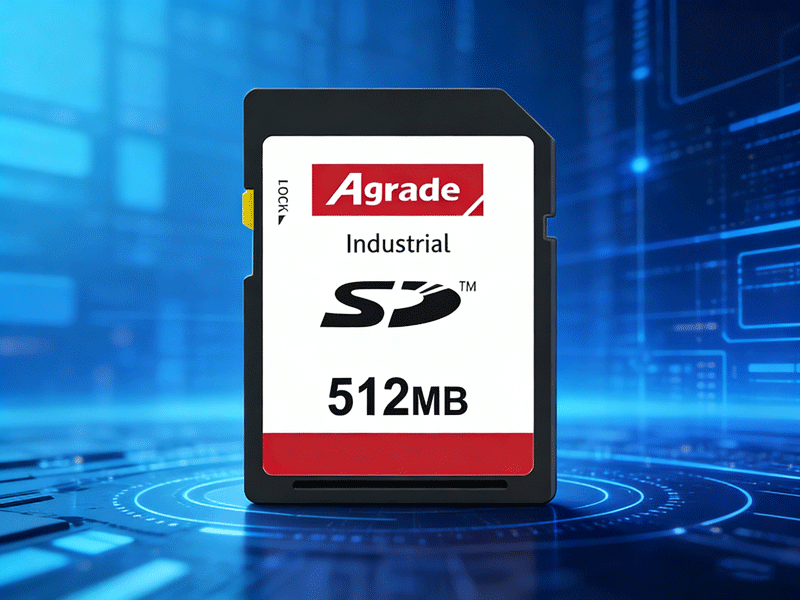
The core advantages of industrial-grade SLC memory cards focus on three dimensions: life, stability, and data security. In terms of service life, the P/E cycle count of SLC flash memory exceeds 100,000 times, and some military-grade models even exceed 1 million times, 10 to 30 times that of consumer-grade TLC cards. Combined with wear-leveling technology, actual service life can be further extended. Data retention time is up to 10 years, ensuring long-term stable storage even when powered off. In stability, SLC flash memory maintains stable read-write speeds without obvious degradation, supporting -40℃ to 85℃ operation and ±15kV ESD protection.
The shortcomings of industrial-grade SLC memory cards are also prominent, mainly in cost and capacity. Since SLC stores only 1bit per cell, the manufacturing cost per unit capacity is much higher than MLC and TLC. The price of an industrial-grade SLC card of the same capacity is 2 to 3 times that of an MLC version and 5 to 10 times that of a consumer-grade TLC card, significantly increasing equipment procurement costs. In terms of capacity, the upper limit is low, with mainstream models ranging from 128MB to 512MB. Products above 1GB have extremely low cost-effectiveness, unable to meet large-capacity storage needs.
In addition, the write throughput of SLC memory cards is limited, with a typical sequential write speed of 10 to 20MB/s, suitable for industrial logs and program storage but not for high-speed writing scenarios. Based on these characteristics, industrial-grade SLC memory cards are suitable for industrial scenarios with "more reads than writes, cyclic coverage, and critical data", such as PLC program storage, on-board equipment, and financial terminals. For large capacity and high speed, choose industrial-grade MLC cards; for non-critical scenarios, ordinary industrial-grade cards can meet needs without bearing high SLC costs.

-
Products
Advantages
-
Solutions
-
News
About us
-
Contact us
Tel:+86 19926658803
Whatsapp:+86 19926658803
lianle1210@163.com
Address: 30CF, Caihong Building, Caihong Road, Futian District, Shenzhen City, Guangdong Province, China


Friendly Links:
