















News


 电商部
电商部  2026-03-18 16:46:42
 Lifespan & Durability of Wide Temperature mSATA SSDs for Industrial Deployment
Industrial systems require storage solutions that deliver years of uninterrupted service, and Wide Temperature mSATA SSDs are engineered for exceptional lifespan and durability far beyond consumer-grade drives. Their longevity is not accidental—it stems from high-quality components, smart firmware, and rugged design that resists wear, environmental damage, and heavy workloads. Understanding the factors that influence lifespan helps maximize the return on investment for industrial deployments.
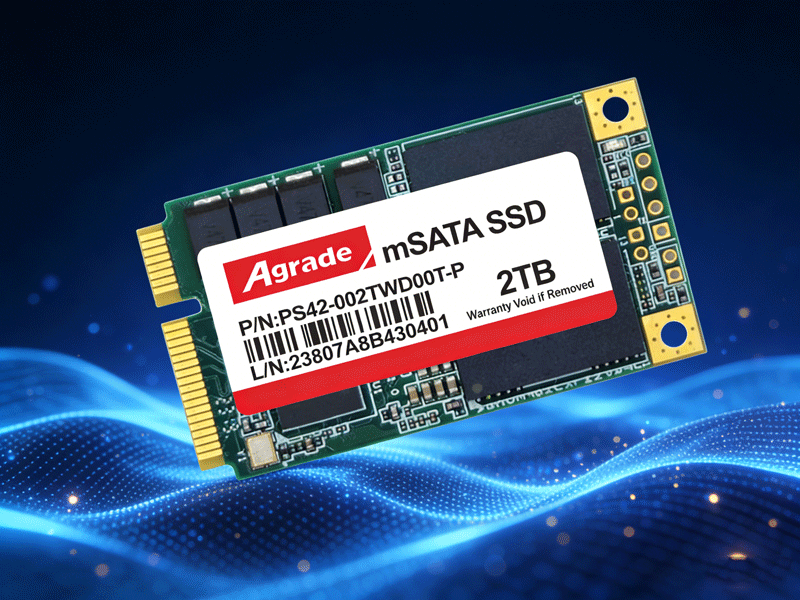
The NAND flash memory type is the primary driver of lifespan. Industrial Wide Temperature mSATA SSDs use robust flash architectures: SLC (Single-Level Cell) flash offers up to 100,000 erase/write cycles for ultra-long life; MLC (Multi-Level Cell) provides 3,000–10,000 cycles for balanced performance and cost; high-grade 3D TLC delivers 1,000–3,000 cycles for cost-effective industrial use. All are vastly more durable than consumer QLC flash, which only supports a few hundred cycles and fails quickly under heavy industrial loads.
Firmware optimizations play a critical role in extending lifespan. Global wear leveling distributes read/write operations evenly across all flash cells, preventing localized fatigue that causes early failure. This ensures no single cell is overworked, maximizing the entire drive’s service life. S.M.A.R.T. health monitoring tracks usage patterns, temperature history, and remaining lifespan, enabling predictive maintenance to replace drives before failure. Wide Temperature mSATA SSDs also have a high MTBF (Mean Time Between Failures) rating, often exceeding 2 million hours for industrial models.
Environmental hardening further boosts durability. These drives are built to withstand high shock (up to 1500G) and vibration (up to 20G), matching the rigors of mobile and industrial equipment. Moisture-resistant coatings and wide-temperature components prevent physical degradation from humidity or thermal stress. With proper usage—avoiding constant full-capacity writes and unregulated power spikes—a Wide Temperature mSATA SSD can operate reliably for 5–10 years in industrial settings, making it a cost-effective long-term storage solution. (

-
Products
Advantages
-
Solutions
-
News
About us
-
Contact us
Tel:+86 19926658803
Whatsapp:+86 19926658803
lianle1210@163.com
Address: 30CF, Caihong Building, Caihong Road, Futian District, Shenzhen City, Guangdong Province, China


Friendly Links:
